
 +44 7887081915




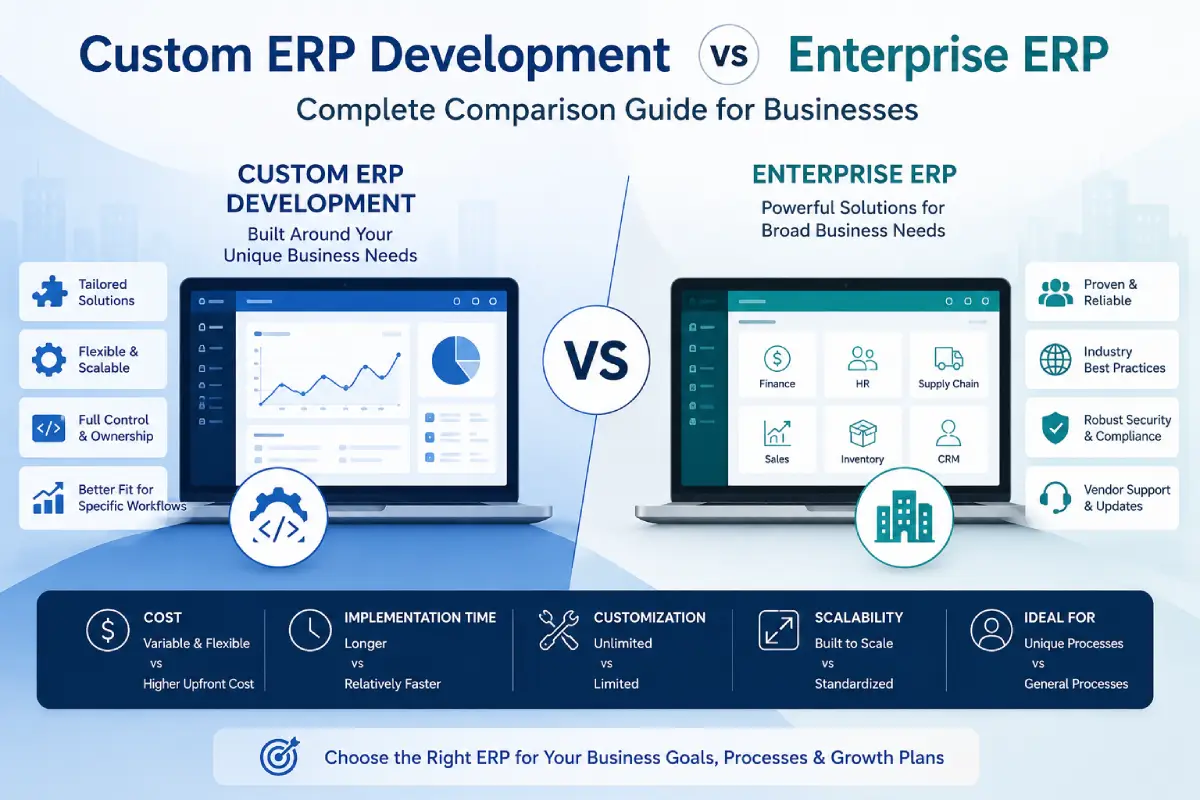
Custom ERP Development vs Enterprise ERP: Complete Comparison Guide for Businesses
ERP Development
 By Gomilestone
 Jun 11, 2026
Custom ERP Development vs Enterprise ERP: Which Solution Is Right for Your Business?
As businesses grow, managing operations through spreadsheets, disconnected software, and manual processes becomes increasingly challenging. This is where ERP (Enterprise Resource Planning) systems help organizations centralize operations, automate workflows, and improve decision-making.
However, one of the most common questions business owners ask is:
Should we invest in Custom ERP Development or choose an Enterprise ERP platform?
The answer depends on factors such as business size, number of users, operational complexity, budget, customization requirements, and long-term growth plans.
In this guide, we compare Custom ERP Development and Enterprise ERP solutions to help you choose the right ERP strategy for your organization.
What is Custom ERP Development?
Custom ERP Development involves building an ERP system specifically tailored to your business processes, workflows, approval structures, and reporting requirements.
Instead of changing your business processes to fit a software product, the software is developed around your business.
Typical Modules in a Custom ERP
- Lead Management
- CRM Integration
- Inventory Management
- Procurement Management
- Vendor Management
- Production Planning
- Warehouse Management
- HR & Payroll
- Attendance Tracking
- Project Management
- Finance & Accounting
- Service Management
- Reporting & Analytics
Custom ERP solutions are particularly beneficial for organizations with unique workflows or industry-specific operational requirements.
What is Enterprise ERP?
Enterprise ERP refers to large-scale ERP platforms developed by established software vendors such as:
- SAP
- Oracle NetSuite
- Microsoft Dynamics 365
- Odoo Enterprise
- Salesforce Platform
These systems offer predefined modules and industry-standard workflows that can be configured according to business requirements.
Enterprise ERP solutions are widely adopted by medium and large organizations seeking faster implementation and standardized processes.
Custom ERP Development vs Enterprise ERP: Quick Comparison
| Feature | Custom ERP Development | Enterprise ERP |
|---|---|---|
| Ownership | Complete Ownership | Vendor Ownership |
| Initial Investment | Medium to High | Medium |
| Monthly Licensing | No | Yes |
| User-Based Pricing | No | Yes |
| Customization | Unlimited | Limited |
| Scalability | High | High |
| Implementation Time | 2-8 Months | 1-6 Months |
| Vendor Dependency | None | High |
| Data Control | Complete | Vendor Controlled |
| Third-Party Integrations | Flexible | Vendor Dependent |
| Long-Term Cost | Lower | Higher |
Cost Comparison: Custom ERP vs Enterprise ERP
One of the biggest deciding factors is cost.
Custom ERP Development Cost in India
| Business Size | Estimated Investment |
|---|---|
| Small Business | ₹5 Lakh – ₹15 Lakh |
| Medium Business | ₹15 Lakh – ₹40 Lakh |
| Large Enterprise | ₹40 Lakh – ₹1 Crore+ |
Once developed, businesses generally incur only:
- Hosting Costs
- Maintenance Costs
- Enhancement Costs
There are no recurring per-user license fees.
Enterprise ERP Cost
| Users | Estimated Annual Cost |
|---|---|
| 10 Users | ₹3 Lakh – ₹10 Lakh |
| 25 Users | ₹8 Lakh – ₹20 Lakh |
| 50 Users | ₹15 Lakh – ₹40 Lakh |
| 100+ Users | ₹40 Lakh – ₹1 Crore+ |
Most Enterprise ERP platforms charge per user, causing costs to increase as the organization grows.
Which Businesses Should Choose Enterprise ERP?
Enterprise ERP solutions are generally suitable for:
- Startups
- Small Businesses
- Companies with Standard Processes
- Organizations needing Quick Deployment
- Businesses with Limited Customization Requirements
If your organization has fewer than 10 active users and standard operational workflows, Enterprise ERP may provide a faster and more economical starting point.
Which Businesses Should Choose Custom ERP Development?
Custom ERP Development is generally suitable for:
- Manufacturing Companies
- Logistics Businesses
- NBFCs
- Healthcare Organizations
- Multi-Location Businesses
- Companies with 20+ Users
- Businesses Requiring Process Automation
As user count and operational complexity increase, Custom ERP often becomes more cost-effective than recurring enterprise licensing models.
Advantages of Custom ERP Development
Complete Ownership
You own:
- Source Code
- Database
- Business Logic
- Infrastructure
This eliminates vendor dependency and provides long-term flexibility.
Unlimited Customization
Every module can be designed according to your operational requirements.
Examples include:
- Manufacturing Workflows
- Approval Hierarchies
- Production Planning
- Compliance Processes
- Industry-Specific Reporting
Better Long-Term ROI
Although the initial investment may be higher, organizations avoid recurring license fees that accumulate year after year.
Flexible Integrations
Custom ERP solutions can integrate with:
- CRM Systems
- Ecommerce Platforms
- Mobile Applications
- Payment Gateways
- Accounting Software
- BI & Analytics Tools
without vendor restrictions.
Advantages of Enterprise ERP
Faster Implementation
Most functionality already exists.
Organizations can begin using modules within weeks instead of months.
Proven Industry Processes
Enterprise ERP vendors have refined their platforms through years of implementation experience.
Vendor Support
Benefits include:
- Documentation
- Training
- Technical Support
- Product Updates
Global Compliance
Enterprise ERP systems are often suitable for multinational organizations operating across multiple countries.
Challenges of Custom ERP Development
- Higher Initial Investment
- Longer Development Timeline
- Requirement Gathering Phase Required
- Ongoing Maintenance Responsibility
Challenges of Enterprise ERP
- User-Based Licensing Costs
- Limited Customization
- Vendor Lock-In
- Increasing Costs as Teams Grow
- Dependency on Vendor Roadmap
Decision Matrix: Which ERP Solution Should You Choose?
| Scenario | Recommended Option |
|---|---|
| Startup with 5 Users | Enterprise ERP |
| Small Business with Standard Workflows | Enterprise ERP |
| Business with 20+ Users | Custom ERP Development |
| Manufacturing Company | Custom ERP Development |
| Logistics Company | Custom ERP Development |
| NBFC | Custom ERP Development |
| Healthcare Organization | Depends on Compliance Needs |
| Global Enterprise | Enterprise ERP |
Why Manufacturing Companies Often Prefer Custom ERP Development?
Manufacturing businesses typically require:
- Production Planning
- Inventory Tracking
- Procurement Management
- Vendor Management
- Warehouse Operations
- Quality Control
- Dispatch Tracking
These processes often differ significantly between organizations.
As a result, many manufacturing companies choose Custom ERP Development to align software with their exact operational workflows.
Future Trends in ERP Development
AI-Powered ERP Systems
Modern ERP platforms are increasingly using AI for:
- Demand Forecasting
- Predictive Maintenance
- Inventory Optimization
- Business Intelligence
- Customer Insights
Mobile ERP Applications
Business owners and managers now expect real-time access through mobile devices.
Real-Time Analytics
Modern ERP solutions provide dashboards that support faster and more informed decision-making.
Final Verdict
There is no universal answer when choosing between Custom ERP Development and Enterprise ERP.
Choose Enterprise ERP if:
- You need quick implementation
- Your processes are largely standard
- You have a small team
- You want lower upfront investment
Choose Custom ERP Development if:
- You need complete flexibility
- You have unique workflows
- You require extensive integrations
- You want long-term cost efficiency
- You have 20+ users or multiple departments
For many growing businesses, Custom ERP Development provides greater flexibility, ownership, scalability, and ROI over the long term.
Need Help Choosing the Right ERP Solution?
At GoMilestone, we help businesses evaluate, design, and implement ERP solutions tailored to their operational requirements.
Whether you need Custom ERP Development, Manufacturing ERP Software, CRM-ERP Integration, or Enterprise Software Solutions, our experts can help you identify the most cost-effective and scalable approach.
Contact GoMilestone today for a free ERP consultation and solution assessment.
FAQs
What is the difference between Custom ERP Development and Enterprise ERP?
Custom ERP Development involves building software specifically for your business, while Enterprise ERP uses pre-built platforms that can be configured according to your needs.
Is Custom ERP Development cheaper than Enterprise ERP?
Over the long term, Custom ERP Development can be more cost-effective because it avoids recurring user-based licensing fees.
How much does Custom ERP Development cost in India?
Custom ERP Development typically starts from ₹5 lakh and can exceed ₹1 crore depending on project complexity and business requirements.
Which ERP solution is best for manufacturing companies?
Manufacturing companies often benefit from Custom ERP Development because production workflows, inventory management, and procurement processes typically require specialized functionality.
Can Custom ERP integrate with CRM and mobile apps?
Yes. Custom ERP solutions can seamlessly integrate with CRM systems, ecommerce platforms, mobile applications, accounting software, and third-party tools.
How many users justify investing in Custom ERP Development?
Businesses with approximately 20+ active users often find Custom ERP Development more economical and scalable than recurring enterprise licensing models.
Recent Knowledge Series


Follow Us


Have an Idea? Let's Build It Together
Transform your vision into reality with our expert development team. We're ready to bring your digital products to life.
- Free Consultation
- No Obligation Quote
- 24/7 Support

500+ Reviews

500+ Reviews
🌍 Clients Across 15+ Countries
Trusted globally by businesses worldwide