
 +44 7887081915




NBFC Collection Management Software: Features and Cost (2026)
Custom Software Development
 Nov 03, 2026
For most NBFCs, growth is not limited by how fast they can disburse loans. It is limited by how well they collect them. A rising DPD bucket eats margin, ties up the team in phone calls, and creates compliance risk if recovery agents are not managed well.
This guide explains what collection management software for NBFCs and lenders should do, how it fits with your loan management system, and what it typically costs to build in India in 2026.
What is NBFC collection management software?
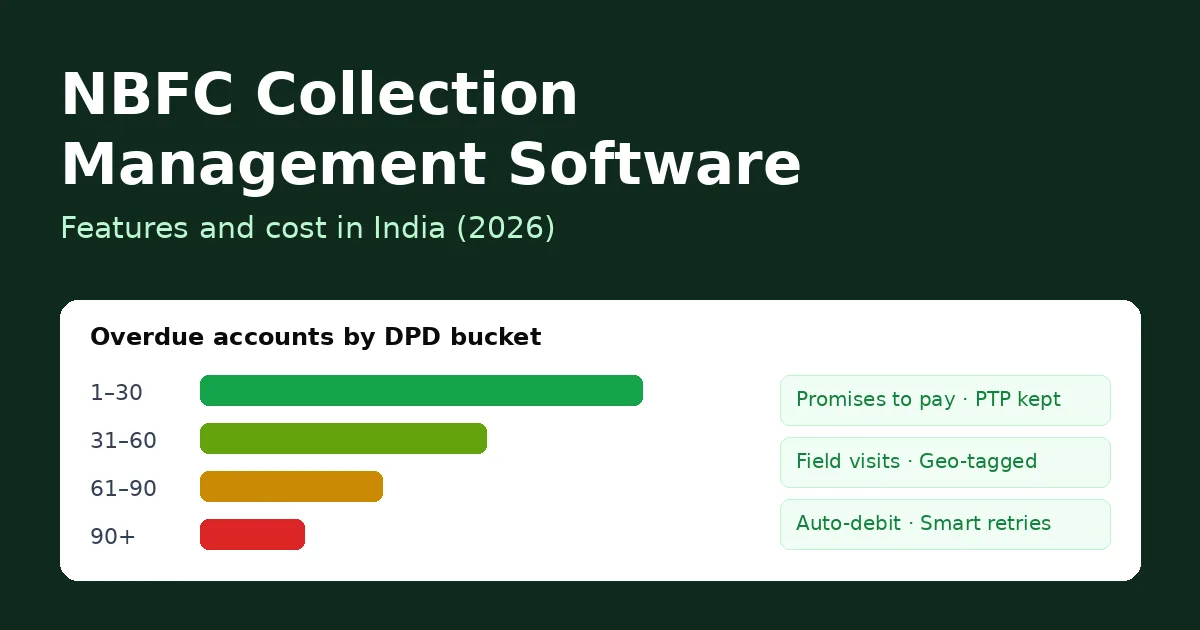
Collection management software tracks every loan that is due or overdue and decides what should happen next: an automatic reminder, a retry of the auto-debit, a call from the tele-calling team, or a visit from a field officer. It gives managers one live view of overdue accounts by bucket, branch, product and agent, so nothing slips through spreadsheets and WhatsApp groups.
It usually sits next to your loan management system (LMS). The LMS holds the loan, the schedule and the ledger. The collection system works the overdue cases and posts every payment and promise back to the LMS.
Planning a collection system for your NBFC?
Share your loan products, buckets and team size, and our lending software team will send a phased plan and estimate.
Must-have features
1. DPD buckets and case allocation
- Automatic grouping of accounts into buckets (for example 1–30, 31–60, 61–90 and 90+ days past due)
- Rules that assign cases to tele-callers, field officers or agencies by bucket, location, product and loan size
- Reassignment when an agent is on leave or a case has been idle too long
2. Reminders and auto-debit retries
- SMS, email and WhatsApp reminders before and after the due date, in the borrower's language
- Payment links in every reminder, so the borrower can pay in one tap
- Smart re-presentation of bounced auto-debit mandates (NACH or UPI AutoPay) on the days the account is most likely to have funds
3. Tele-calling workspace
- A daily call list ranked by risk and amount
- Click-to-call with call outcome, promise-to-pay (PTP) date and notes in a few taps
- Automatic follow-up when a promise is broken
4. Field collection mobile app
- Route planning for the day's visits
- Geo-tagged visits with photos, so managers can verify that a visit happened
- On-the-spot receipts, with cash, UPI and cheque collection recorded instantly
- Offline mode for areas with weak network, syncing when the officer is back online
5. Compliance and conduct controls
RBI expects lenders to stay responsible for how their staff and recovery agents behave. Good software makes the rules hard to break:
- Calls and visits allowed only within permitted hours
- Call recording and a full audit trail of every contact
- Agency and agent details shared with the borrower before contact
- Pre-approved message templates, with no free-text threats or abusive language
- Escalation and grievance tracking
Rules change, so the system should let your compliance team update timings, templates and approvals without new code.
6. Settlement and restructuring workflows
- One-time settlement (OTS) and restructuring requests with maker-checker approval
- Limits by role, so field staff cannot offer waivers they are not allowed to
7. Dashboards and reports
- Collection efficiency by bucket, branch, product and agent
- Roll-forward and roll-back rates, PTP kept versus broken, and cost per rupee collected
- Daily summaries for management, and data ready for regulatory and lender reporting
8. AI-assisted prioritisation (optional)
Once you have six to twelve months of repayment data, a simple scoring model can predict which accounts are likely to roll into the next bucket. Your team then spends calls and visits where they make the biggest difference. Start with clear rules first, and add scoring when the data is ready.
Ready-made product or custom build?
A ready-made collections product can work if your products and processes are standard. NBFCs often choose a custom build when they have:
- A mix of products, such as MSME loans, gold loans, vehicle loans or co-lending, each with different collection rules
- A large field team that needs a mobile app built around their actual day
- An existing LMS that a ready-made tool cannot integrate with cleanly
- Per-user licence costs that grow faster than the loan book
A custom system also means you own the code and the data, which matters for audits and for moving vendors later.
How much does NBFC collection management software cost in India?
Typical build costs in 2026 (approximate USD at about ₹95 to $1):
| Scope | What's included | Typical cost | Timeline |
|---|---|---|---|
| Basic | DPD buckets, case allocation, reminders with payment links, tele-calling workspace, basic reports | ₹3–6 lakh (about $3,200–$6,300) | 6–10 weeks |
| Standard | Basic + field collection app with geo-tagging and receipts, auto-debit retries, settlement workflow, LMS integration | ₹6–14 lakh (about $6,300–$14,700) | 10–16 weeks |
| Advanced | Standard + multi-product rules, agency management, full compliance controls, management dashboards, AI scoring | ₹14–30 lakh (about $14,700–$31,600) | 4–7 months |
What changes the cost: the number of loan products and collection rules, whether you need a field app (and offline mode), integration with your LMS and payment gateways, the depth of compliance controls, and the number of reports. Running costs (hosting, SMS and WhatsApp messages, call recording storage) are separate and usually small compared with the amount recovered.
If you also need the loan management system itself, see our guide to loan management software cost.
How to roll it out without disrupting collections
- Start with one bucket. Launch for 1–30 DPD first, where reminders and calls have the biggest effect.
- Move tele-calling next, then the field team once the call workflow is stable.
- Run old and new reports side by side for a few weeks to build trust in the numbers.
- Add settlement, agencies and scoring in later phases.
GoMilestone builds custom lending and collection platforms for NBFCs and fintech lenders, from field collection apps to full NBFC software development. See how we built a DSA mobile app for a leading NBFC.
Want an estimate for your collection software?
Tell us how you collect today (tele-calling, field team, agencies) and we'll suggest the right first phase and its cost.
FAQs
What is the difference between an LMS and collection management software?
The LMS manages the loan itself: schedule, interest, ledger and closure. Collection software manages the work of recovering overdue amounts: allocation, reminders, calls, visits and settlements. Many NBFCs run both, connected so payments update in real time.
How much does NBFC collection software cost in India?
A basic custom system typically costs ₹3–6 lakh (about $3,200–$6,300). A standard system with a field app and LMS integration costs ₹6–14 lakh, and an advanced multi-product platform ₹14–30 lakh, depending on scope.
How long does it take to build?
A basic version can go live in 6–10 weeks. A standard system with a field app usually takes 10–16 weeks.
Can collection software help with RBI compliance on recovery agents?
Yes. It can restrict contact to permitted hours, record calls, use approved message templates, share agent details with borrowers and keep an audit trail. The lender remains responsible, but the software makes the rules much easier to follow and prove.
Does the field app work without internet?
It can. Offline mode lets officers record visits, photos and receipts in low-network areas and sync automatically when they are back online.
Recent Knowledge Series



Follow Us


Have an Idea? Let's Build It Together
Transform your vision into reality with our expert development team. We're ready to bring your digital products to life.
- Free Consultation
- No Obligation Quote
- 24/7 Support




Clients Across 10+ Countries